






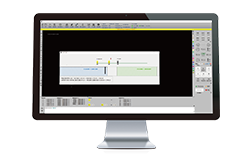





BOCHU Launches Integrated Inkjet Marking, Scribing and Cutting Solution to Enhance Quality and Efficiency in Shipbuilding

In response to shipbuilding's growing demand for digital and intelligent upgrading, Shanghai BOCHU Electronic Technology Co., Ltd. ("BOCHU") has officially launched its Integrated Inkjet Marking, Scribing and Cutting Solution. Combining digital collaboration, high-efficiency printing, precise marking, and stable operation, the solution helps shipyards improve steel plate marking efficiency and production stability while streamlining the handover between production processes.
Accelerating Shipbuilding Transformation Drives Demand for Automated Steel Plate Marking
In shipbuilding, steel plates go through multiple operations including nesting, marking, cutting, sorting, and assembly. Markings such as ship numbers, section numbers, part numbers, and production information serve as essential references for accurate information transfer and smooth process flow.
However, traditional methods — manual writing, scribing, and flame powder marking — suffer from inconsistent marking quality, high labor and consumable costs, and low efficiency, and cannot meet the requirements of information-rich markings such as complex characters and QR codes. Conventional UV inkjet solutions, in turn, face challenges such as printhead clogging, collisions caused by plate deformation, and complex maintenance, undermining the stability of continuous production.
As shipbuilding accelerates its digital and intelligent transformation, steel plate marking is no longer simple labeling. It must now balance printing efficiency, marking precision, operational stability, and process collaboration to meet the automated, continuous production requirements of modern shipyards.
Four Core Advantages for an Efficient and Stable Marking Solution
To meet these industry needs, BOCHU's Integrated Inkjet Marking, Scribing and Cutting Solution is systematically designed around real-world shipyard production rhythm, plate specifications, and site conditions. It connects the entire workflow — design, nesting, marking, and cutting — delivering a comprehensive upgrade of the marking process through digital integration, synchronized multi-printhead printing, intelligent sensing and control, and a stable ink circuit.

1. Digital Collaboration: Connecting the Entire Design–Nesting–Marking–Cutting Workflow. Integrated marking and cutting reduces process handover time by 30% to 50%, enabling efficient exchange of production information.
BOCHU's solution focuses not only on improving individual operations, but on aligning the marking stage with the shipyard's overall production flow. Built on a digital software system, it automatically generates Mark points and reuses marking and cutting drawings, reducing duplicated drafting and manual work. Vision-based automatic recognition of steel plate numbers and matching of the corresponding production drawings simplify pre-printing preparation. The system also supports interference detection for marking information, automatically adjusting mark position and size to optimize the printing layout with minimal manual intervention.
For production collaboration, the solution enables one-stop, high-efficiency linking of nesting, marking, cutting, and sorting on the same platform, and coordinates printing operations with line rhythm to reduce waiting and duplicated work between processes. It also integrates with factory MES systems; combined with automatic work reporting and ink consumption statistics, it provides data support for production management, cost control, and information traceability.

2.High-Efficiency Printing: Synchronized Multi-Printhead Operation Completes Complex Markings in One Pass
For shipyards' large plate formats, rich marking content, and tight production takt, BOCHU's solution adopts a modular inkjet printer module design, offering half-width and full-width configurations as well as custom options to flexibly match each shipyard's production requirements.
Take the 40-printhead full-format configuration as an example: through synchronized multi-printhead motion and coordinated printing, ship numbers, section numbers, part numbers, pallet numbers, material grades, flow directions, processing symbols, bevel information, QR codes, and more are printed onto the steel plate surface in a single pass — no repeated positioning or segmented marking required.
According to real-world shipyard test data, printing speed reaches 25 meters per minute — a leap of 20 to 40 times in efficiency over single-printhead solutions. Even in actual production with loading and unloading time included, the system maintains a high output of 20 plates per hour. Overall marking efficiency is 33% higher than comparable solutions, providing strong support for fast pace, continuous shipyard production.

3. Precise Marking: Intelligent Edge Finding and Multi-Head Stitching Ensure Print Quality
To handle surface unevenness, position deviations, and complex marking content on large steel plates, BOCHU's solution relies on intelligent positioning and coordinated multi-printhead control to safeguard printing precision and marking quality.
The device uses line-laser scanning combined with automatic edge finding and plate status recognition to detect plate position and surface height variations in advance, providing the basis for print positioning and height adjustment.
Meanwhile, high-precision motion control, staggered printhead stitching, and fine adjustment of the inkjet printer units achieve multi-printhead stitching precision below 1 mm, ensuring smooth transitions between printheads and reducing stitch misalignment and broken markings.
Complex characters, fine lines, QR codes, and auxiliary process information are all printed clearly and continuously, improving information recognition efficiency and processing accuracy in downstream operations.

4. Stable Operation: High Printing Distance with Intelligent Anti-Collision, and a Self-Circulating Ink System Reduce Maintenance
Long-term stability is the cornerstone of continuous shipbuilding production. Facing warping, wave-shaped deformation, and protruding weld beads, BOCHU's solution provides dual protection — a printing height of more than 20 mm above the plate surface combined with intelligent follow control — precisely avoiding printhead collisions, substantially reducing maintenance costs, and keeping the production line running efficiently.
The device scans the plate surface in advance with a line laser and, together with independent Z-axis dynamic height adjustment and mechanical anti-collision protection, adapts promptly to plate height variations for smoother printhead motion. In case of abnormal interruption, the system automatically locates the breakpoint and resumes printing, reducing rework.
To tackle the printhead clogging and maintenance problems, BOCHU's solution uses a dual-negative-pressure circulating ink circuit with ink self-circulation, constant-temperature control, automatic cleaning, and printhead light shielding and moisturizing — resolving the clogging issues of conventional solutions and reducing print anomalies caused by ink solidification, bubbles, and contaminants.
With multiple anti-collision protections and automatic maintenance mechanisms, the risk of unplanned downtime is effectively reduced, supporting stable 7×24 continuous operation to meet the demands of high-intensity, continuous shipyard production.

Deployed in Multiple Shipyards, Pioneering a New Path for Intelligent Ship Marking
BOCHU's Integrated Inkjet Marking, Scribing and Cutting Solution has passed project acceptance at several leading shipbuilding enterprises, validating its capability for large-size steel plates, high-takt production, and complex site conditions. Backed by modular design and system integration capabilities, the solution can also be customized for different shipyards' plate specifications, production takt, and line layouts to meet diverse production needs.
As shipbuilding's digital and intelligent transformation deepens, steel plate marking is evolving from an isolated production step into a key link in automated production and information collaboration. By integrating inkjet printing technology, intelligent control, and digital systems, BOCHU offers shipbuilding enterprises a new technical path to higher productivity and efficient multi-process coordination, and provides practical experience for the industry's intelligent upgrading.

